Make your SaaS the safer choice from the first click.
Easier to trust. Easier to explain. Easier to move forward with. We find and fix the trust leaks across your buyer journey.
The SaaS buyer has changed.
Your trust path has not.
A short walkthrough of why good-fit deals stall — and the four gates every buyer moves through before they say yes.
No time for the video? The whole story is below, built to skim. Tap the navigator (bottom-right) any time to jump to what matters to your role.
Your demos go well. Then the deal goes quiet.
Your product may be strong. Your market may need it. Buyers may even say "this is interesting." And then momentum disappears.
Most teams call this a sales problem. Sometimes it is. But very often it's a trust problem — the quiet kind. Not "we don't believe you." It's a stack of unanswered questions running quietly in their head:
Eight different worries — but only four kinds. Every doubt is missing clarity, proof, safety, or a way to sell it internally.
So they pause. In your CRM the deal still looks alive. In the buyer's mind, trust has already started leaking.
That is exactly what the First-Click Trust System™ is built to fix. Not with fake claims. Not with magic revenue numbers. By making every important touchpoint feel clear, proven, safe, and easy to act on.
To you it's separate pieces. To the buyer it's one signal.
The buyer judges the full signal around the product — and reads it all as one read on whether you're safe to choose.
And that one signal says one of two things:
- "This company is clear."
- "This company is serious."
- "This company understands our problem."
- "This company has proof."
- "This is safe to take forward."
- "This will make me look smart internally."
- "I need to think about this."
- "I need to compare more options."
- "I need to ask my team."
- "I'm not ready to take this risk yet."
Deals slow down in that second signal. Not because buyers are stupid. Not because your product is weak. Because the trust path isn't strong enough yet.
The new fight isn't "better product." It's "safer to choose."
A few years ago, building good software was the hard part. Now building software is easy — so more tools launch, more categories crowd, and more SaaS sounds the same.
Buyers are more aware now. They've seen big claims, shiny tools, software that never got adopted, AI products that appeared fast and disappeared faster. They're harder to impress — and they're asking better questions:
Trust is no longer a soft thing. It's part of the sales system, the brand, conversion, pipeline, and category leadership. Weak trust signals = buyers slow down. Strong, aligned signals = buyers move.
It's about reducing buyer doubt.
You already know the product is good. But your buyer can't buy what you know — only what they can see, understand, believe, and explain. That's where momentum leaks — strong on one side, leaking on the other:
The team doesn't need more noise. They need a cleaner trust path.
The buyer needs more than a demo. They need decision confidence.
The whole system runs on one equation. Your buyer needs all four. If any one is weak, the deal slows down.
Tap each gate to charge it. Miss one — the deal slows.
Can they understand what you do — and explain it to their boss in one sentence?
Can they find proof that feels real, specific, and close to their world?
Can they see the risk is handled — implementation, security, procurement, adoption, cost?
Can your champion convince the people who were never in the room?
The gap between "good product" and "safe to choose."
This is the work when interest is real but movement isn't. If you recognize these signals, trust is leaking somewhere on the path:
Your buyer doesn't reject you. They just slow down. Every signal above traces back to one of four gates.
Each of these helps. None of them is the whole job.
The First-Click Trust System sits between brand, sales, buyer psychology, founder authority, and decision support — where the buyer actually decides.
Each discipline helps. The system is where they connect — none of them is the whole job alone.
A better website can help.
But the website alone doesn't close the trust gap.More leads can help.
But leads sent into a weak trust path just create more stalled conversations.Founder authority can help.
But random founder posts don't create a buyer decision path.Better calls can help.
But even a good call dies if the buyer has nothing strong to forward internally.Clear messaging can help.
But messaging without proof, risk removal, and internal-sell assets is incomplete.The goal isn't to make you look fancy. The goal is to make the buyer feel safer moving forward.
Buyers don't buy alone anymore.
In complex B2B SaaS, the person who likes your product is rarely the only one who decides. Your champion has to convince a room you're not in.
Most companies leave the champion alone. They try to remember the demo, describe the ROI, answer objections, and defend "why now" — all without the right material. So the deal slows. Not because they stopped caring. Because they weren't equipped.
When your champion says "I like this," they should also have the material to say "here's why we should move."
One path. Trust builds or leaks at every step.
Website → founder → proof → demo → follow-up → internal sell → procurement → decision. We map it, then we score it.
↔ Swipe the path. A real sequence — order carries information. The first node is always the "first click."
They need to know what you do, who it's for, the problem you solve, why it matters now, and why you're worth their time.
They need a clear story, proof that feels close to their world, a simple way to compare you — and to feel the product is useful, not just interesting.
They need a clear follow-up, a memo, a business case, risk answers, rollout clarity, proof to share, and a next step that feels safe.
That's the trust path. That's what we build.
Built for strong products with a leaky path.
When the product is good but the buyer journey doesn't make that obvious fast enough.
Strong fit for Seed–Series B SaaS: AI, DevTools, cybersecurity, data platforms, workflow automation, HRTech, FinTech, vertical SaaS, and new or technical categories.
- A real product with some customer proof.
- A clear sales motion and real demos.
- A founder still involved in many deals.
- A sales team that needs stronger assets.
- Buyers who show interest but don't always move.
You don't need a perfect ARR number. Under $1M with real proof and a serious buyer path? The audit can still make sense. Above $15M with messy, multi-vertical trust systems? Same. The audit exists so we don't guess.
This works best when the product is good, the market is real, and the trust path simply isn't strong enough yet. It's not for:
- Companies with no customers.
- Founders who only want more leads.
- Teams chasing fake growth claims.
- Broken products.
- Founders who want copy without giving context.
- Teams that can't share calls, funnel data, proof, objections, or buyer materials.
- Anyone who wants a pretty landing page with no real strategy under it.
12 places good-fit buyers lose confidence.
Each is something the buyer thinks but rarely says. Tap any leak to see the fix.
every one
01"I don't fully understand what you do."
The buyer has to think too hard. The category is unclear, and the product is explained from the company's side, not the buyer's.
A clear category spine and simple, buyer-facing language.
02"You sound like everyone else."
Too many tools with the same claims — AI-powered, automated, end-to-end, scalable, easy to use. Those words aren't enough anymore.
A sharper point of view, a clearer enemy, and a stronger "why you" story.
03"I don't know why this matters now."
They may understand the product but not the urgency. So they wait.
A why-now narrative tied to business pressure, cost of delay, market timing, and internal priority.
04"Where is the proof?"
Your proof may exist — but if buyers have to hunt for it, it's too weak.
Decision-grade proof: by use case, by role, by objection, by industry, before-and-after.
05"This feels like a small-company risk."
Common for early/growth SaaS. The product is strong, but the buyer asks: can this team support us? Will they be around? Is this risky for me?
An enterprise trust layer across website, founder profile, proof, security answers, rollout plan, and sales material.
06"I like it, but I can't sell it internally."
One of the biggest leaks. The champion wants to move but lacks the words, proof, numbers, or risk answers to convince others.
Internal-sell assets that travel without you.
07"The CFO will ask for ROI."
Many teams avoid ROI to dodge fake promises — correct. But avoiding it completely makes the buyer work too hard.
Simple, honest business-case logic. No fake math — just clear assumptions, scenarios, and cost-of-delay thinking.
08"Security or procurement may block this."
Many deals slow late because risk answers aren't ready.
Procurement-ready material that makes the risk path easier.
09"Implementation feels heavy."
They may like the outcome but fear the work.
A clear rollout path: what happens first, what the team does, what support looks like, and the first signs of progress.
10"Only the founder can create trust."
Common in founder-led SaaS. The founder explains the vision, handles objections, creates belief — but the team can't repeat that trust.
Turn founder trust into assets the sales team can actually use.
11"The story changes across touchpoints."
Website says one thing, the deck another, the founder is sharper on LinkedIn, sales says something different on calls, follow-up is weaker. That creates doubt.
Touchpoint congruence — one story, one proof system, one next step.
12"The buyer has no safe next step."
Sometimes the next step feels too big — not ready for a full demo, or past it and needing something else.
Match the next step to the buyer's stage: cold buyers need clarity, warm buyers need proof, hot buyers need safety and internal-sell support.
The system is custom. The audit tells us what matters first.
We don't build the same stack for every company. Here's the full menu — tap any layer to open it. Each layer acts at a specific point in the buyer's journey.
01Touchpoint Congruence AuditFind where buyers lose clarity, belief, safety, or momentumDiagnose
We map the buyer journey and score the major touchpoints — website, founder profile, sales deck, demo flow, outbound, follow-up, proof, case studies, ROI story, security answers, internal-sell material, procurement path.
02Category SpineMake the product easy to understandBefore
What you are, who it's for, the old way you replace, why it breaks, why now, why you, why not build in-house, why not do nothing, why not the safer-looking competitor.
Your buyer explains you in one sentence. Your team repeats the story without the founder. Your site makes sense in seconds.
03Proof SystemScattered proof → proof buyers can useDuring
Proof by industry, use case, buyer role, and objection. Micro case studies, before-and-after stories, a quote bank, logo/metric structure, proof blocks for the site, proof slides for the deck, proof snippets for follow-up.
Not "more testimonials" — proof in the right place at the right moment.
04Decision LibraryBuyer tools that teach, prove, and moveDuring
Not random lead magnets — decision tools: fit & urgency diagnostic, category clarity page, cost-of-inaction calculator, pipeline-gap calculator, outcome simulator, proof-pack navigator, internal-sell memo, procurement-readiness page.
Buyers don't need three more calls just to take you seriously — and sales doesn't write a custom essay each time proof is asked for.
05Founder Trust LayerFounder authority for buyer trust — not attentionBefore
Founder positioning spine, LinkedIn trust cleanup, featured proof, a founder trust portal, a buyer-facing narrative, posts mapped to objections, content that routes buyers to useful proof and decision tools.
06Internal Sell KitThe material your champion needs after the demoAfter
Champion forward memo, internal email template, six-slide internal mini-deck, buying-committee objection map, role-based proof, CFO logic, security answers, procurement next steps, why-now summary, risk-removal language.
"I like this" becomes "here's why we should move."
07ROI & Business Case SupportHonest logic, not fake numbersAfter
Cost of delay, time saved, manual work reduced, risk reduced, revenue leakage, team capacity. Conservative, expected, and upside cases — with assumptions and payback thinking stated plainly.
08Procurement-Ready PacketStop risk questions becoming deal-killersAfter
Security posture summary, data-handling notes, implementation plan, compliance notes, procurement FAQ, legal handoff notes, risk-reduction answers, technical-buyer FAQ, rollout timeline.
09Sales Follow-Up System"What to send when" — not "just checking in"After
What to send after the first call, after the demo, to the CFO, to security, when they say "not now,"when the deal stalls, when the champion asks for proof, when procurement enters.
Follow-up shouldn't feel needy. It should make the buyer's decision easier.
10Sales Team Usage GuideA trust system only works if the team uses itEnable
What exists, where it lives, when to use it, who it's for, what problem it solves, what objection it handles, what next step it supports. So the team stops guessing.
Same company. Fewer reasons to pause.
Toggle between the before and after. This doesn't mean every buyer closes — that would be a fake promise. It means good-fit buyers get a clearer, safer path to decide.
Before we build anything big, we find what's actually leaking.
The First-Click Trust Audit is the front door. We map the buyer paths that matter most and review the real touchpoints your buyers see — no guessing, no generic advice. Simple journeys stay light; complex ones go deeper.
More paths, more roles in the room, and deeper procurement mean more to map and score. We size your number to the real journey — not a fixed package.
- LinkedIn → website → demo booking → demo → follow-up
- Outbound → landing page → asset → demo → proposal
- Website → product page → case study → demo → procurement
A clear Trust Score and a map your team can use.
Here's the signature output — a simple score showing where trust holds and where it leaks.
Sample score. Every state is paired with a label — color never carries meaning alone.
Alongside the score, you get the full readout:
With the founder and your sales, growth, or revenue lead — what you sell, who buys, where deals slow, what buyers ask before moving, where the founder gets pulled in.
The actual pages, assets, emails, proof, and follow-up your buyers really experience.
A simple score showing where trust is strong and where it leaks.
The three biggest places buyers may be slowing down — named specifically, not "your brand needs to be stronger."
A document your team can use: what's leaking, why it matters, what to fix first, what to build, what to watch, the next best move.
We walk you through the findings. You leave knowing what to change first.
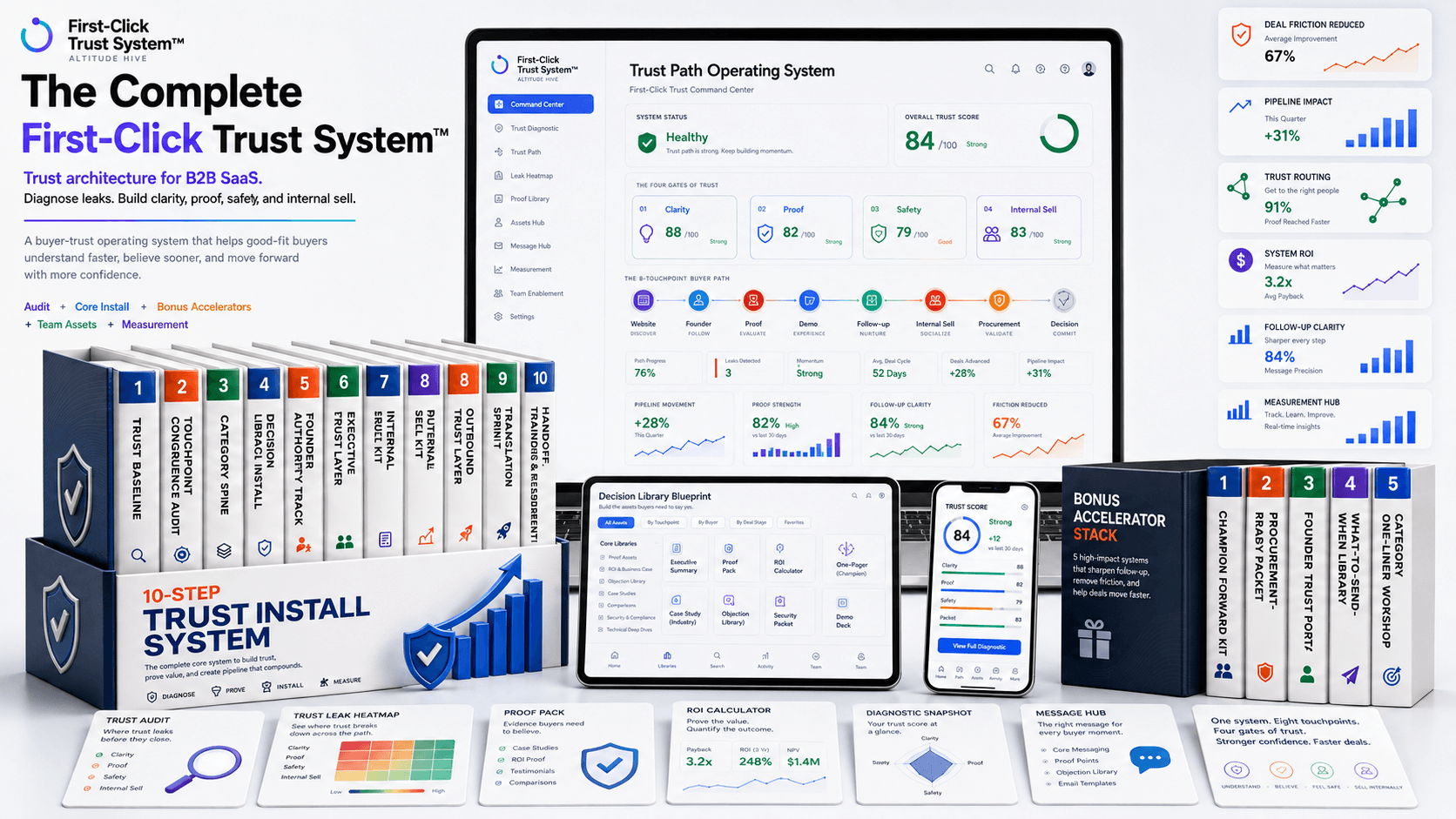
This is what your team walks away with — a clear, shareable readout they can act on without you in the room.
If we can't find 3 clear leaks, you don't pay.
Not "we'll grow revenue by X." Not "we'll cut your cycle by Y." The promise is simpler: we'll find the trust leaks clearly enough that you and your team know what to fix next.
Three honest outcomes.
What we find sets the depth. The audit decides which one you're in — not a sales pitch.
Same logic as the audit: you pay for what your journey actually needs — not a giant system when a focused fix would do, and not a small patch pretending to solve a full buyer-trust problem.
No fake countdown. Just the real deadline.
Buyers aren't getting less skeptical — they're getting more careful, with more options and more people involved. The real urgency is your buyer's next decision cycle.
If your buyer path is unclear now, more traffic won't fix it. If your proof is scattered now, more demos won't fix it. The longer the leak stays hidden, the more pipeline it touches. Find the leak before you build more on top of it.
Audits open in monthly batches; full installs are limited — not fake scarcity, just real depth. We only take installs where we can clearly see a real leak, enough proof to work with, a serious buyer path, and a team willing to give access. If a full install isn't the right move, we'll say so.
Trust Leak Clarity Guarantee
For the audit: if we can't identify at least three clear trust leaks in the path we review, you don't pay for the audit.
For full system work: the guarantee is based on usefulness and quality, not fake revenue promises. If the founder and sales lead don't feel the system is meaningfully clearer, stronger, and more useful than what they had, we keep working through the agreed review process until the core system is usable.
Applies when your team gives access to materials, attends agreed sessions, gives feedback on time, and shares real proof, sales context, and objections — and the issue is quality or usefulness, not lack of participation. We don't guarantee revenue or closed deals. We guarantee the trust system will be clearer, stronger, and more usable than what you had before.
Fair questions. Honest answers.
"We already have a website.
Good. The question isn't whether a site exists — it's whether it helps the buyer understand, believe, and move. Many polished SaaS sites still leak trust: clean page, weak proof; smart message, not repeatable; serious product, no "why now." The website is one touchpoint. We look at the full path.
"We already have case studies.
Good — but buyers need the right proof at the right time. A CFO needs different proof than a user; a champion different than procurement; a cold buyer different than a hot one. A broad case study helps. A decision-grade proof system is stronger.
"Our sales team already follows up.
Yes — but what are they sending? If follow-up is mostly "checking in," it doesn't reduce risk. Good follow-up makes the next decision easier and answers the question the buyer is quietly stuck on.
"We're still early.
That may be fine. You don't need to be huge to need trust — but you do need real proof. With real customers, demos, objections, and buyer movement, the audit can help. With no customers yet, it's probably too early.
"We're not exactly in the ARR range.
Okay. The audit is based on your buyer path, not a rigid label. If your sales motion has trust leaks, we can look. If it's not the right fit, we'll say so.
"Can we just hire a marketer?
A marketer can help with attention. This isn't only attention — it's buyer trust. It connects message, proof, founder authority, sales enablement, decision tools, ROI logic, and internal-sell material. It's closer to building the buyer's decision infrastructure.
"Can AI tools do this?
AI can help draft. It can't understand your buyer trust path without judgment, know which proof matters most, sit inside your sales cycle to see where belief drops, or decide what your champion needs to sell internally. The value is knowing what tools, proof, and messages must exist so the buyer feels safer.
Start where the risk is lowest.
Start with the audit.
You don't have to commit to a build to find out what's leaking. The Touchpoint Congruence Audit shows you exactly where buyers lose trust — and what it would take to fix it.
Audit fee — from $1,000, scoped to your buyer journey, delivered in 7–10 days — is credited toward your build if you move forward within 30 days.
The person across the table.

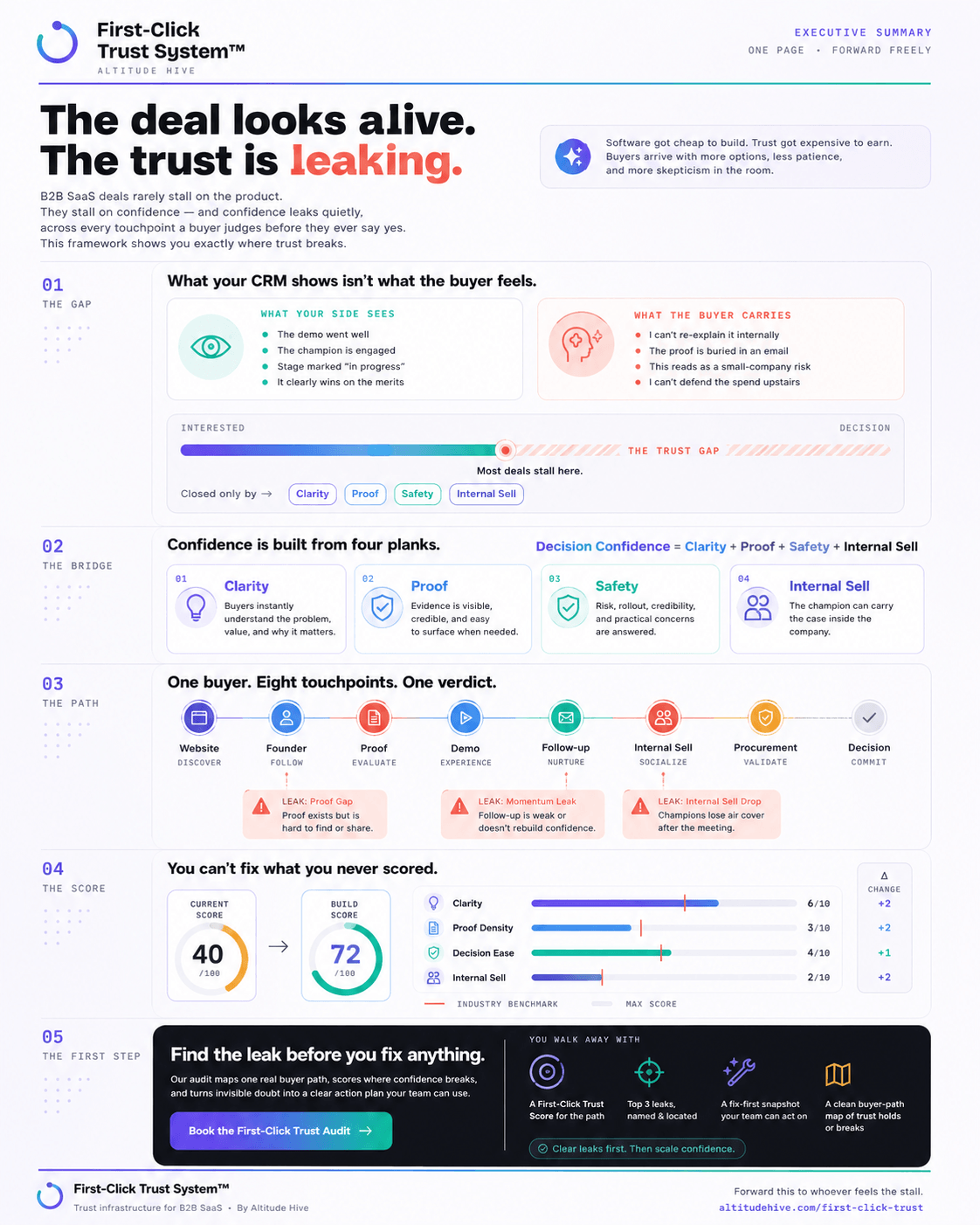
The one-page version, ready to forward.
Everything above on a single page — built to drop into a Slack thread or an email to the person who wasn't on this call.