Proof in Person™Altitude Hive · Trust-to-Pipeline Systems
Make your team feel as credible in the room as your product feels online.
Your product creates interest. Your people create confidence. When the buyer finally meets them, trust either grows — or quietly leaks. This is the system that closes that gap.
But then the buyer meets your team.
And in that moment, a new decision starts.
The buyer is no longer judging only your product.
They are judging your people.
They are silently asking
But because the human experience does not always match the trust created before the meeting.
You have two brands. You only engineered one.
One is the brand you built — every pixel, every slide, perfectly controlled. The other is the human walking into the room. This short film is the whole argument — start to finish.
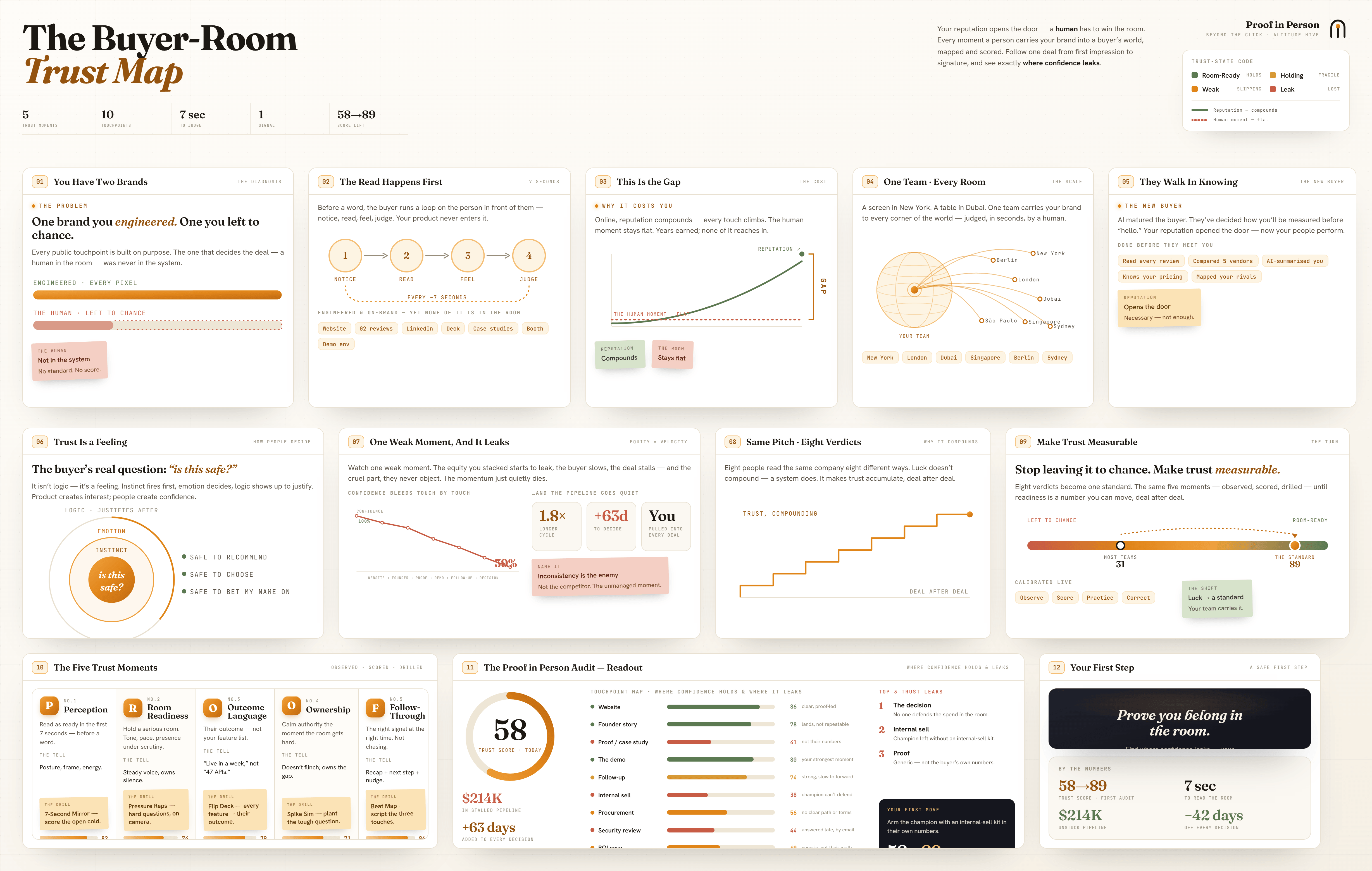
Inside the film
The buyer does not experience your company in parts.
To the buyer, it is all one signal.
Either the signal builds trust. Or it creates doubt.
And doubt is expensive.
What they rarely say out loud
What they say instead
That is how human trust leaks sound.
But if the room did not create enough confidence, the next step becomes weak.
And weak next steps create slow deals.
Your expectation is built online. The verdict lands in the room.
A sharp website, a strong deck, a premium booth, a credible founder — each one raises what the buyer expects. Then they meet the team, and they compare what they expected against what they experienced.
If the team matches or exceeds the expectation, trust grows.
If the team feels below the expectation, trust drops.
This product exists to close that gap.
This is not a soft skills problem.
Most companies mislabel it. They reach for the nearest training category — and miss what is actually breaking.
What companies usually call it
Your people are not just attending meetings. They are carrying the company’s credibility.
Every buyer-facing person is a trust signal.
And if those signals are not aligned, buyers feel it — even when they cannot explain it.
When everything looks polished, the human layer is the tiebreaker.
More buyers are seeing five options that appear almost the same.
The buyer cannot always tell the products apart. They can tell which team feels ready.
So the question is no longer only “Is the product good?”
This is where the human layer matters. Especially —
The buyer is not only checking what you sell.
Global buyers notice small things
These are not small things. They are trust signals.
A weak human moment doesn’t kill the deal. It makes it slow.
That is exactly why it is dangerous. The buyer does not reject you. They just slow down.
This costs your company in ways that are easy to miss.
That is the gap.
Your product may create interest.
Your people must create confidence.
A facilitated buyer-facing readiness system — not another workshop.
Beyond the Click: Proof in Person is a facilitated buyer-facing readiness system for teams that meet prospects, clients, partners, senior stakeholders, and global buyers. It helps your team create more trust in the moments where buyers are watching closely.
We map the real buyer moments your team faces.
We identify where human trust is leaking.
We score the team using a clear framework.
Then we help the team practice, correct, and improve the behaviors that matter most.
The method is simple
Because most teams do not need more lectures. They need live calibration.
They need to see what the buyer may be seeing.
They need to practice the actual moments where trust is won or lost.
The P.R.O.O.F. Mechanics™
Proof in Person is built around the P.R.O.O.F. Mechanics. This framework shows where buyer trust is created — or weakened — in human moments.
Perception · Room Readiness · Outcome Language · Ownership · Follow-Through
Perception
How your team is seen in the first few seconds. Before a person explains anything, the buyer has already formed an impression.
- Appearance
- Grooming
- Posture
- Energy
- Camera presence
- First impression
- Professional readiness
- Role-appropriate credibility
This is not about fashion. This is not about luxury. This is not about looking rich. It is about looking ready.
Room Readiness
How your team behaves inside the room. The room may be physical or virtual. A Zoom room is also a room.
- How they enter
- How they sit
- How they listen
- How they introduce themselves
- How they manage silence
- Eye contact
- Behaviour with senior buyers
- Meeting flow
- Avoiding nervous movement
- Creating professional ease
A capable person can still lose trust if they do not know how to carry themselves in the room.
Outcome Language
How your team explains the company in buyer language. Many teams know the product deeply. That is not the issue. The issue is that they explain from their side.
- Features
- Processes
- Tools
- Internal terms
- Technical details
- Long explanations
But buyers do not always need more detail. They need sharper meaning. They want to know:
What problem does this solve?
Why does it matter now?
What business value does it create?
What risk does it reduce?
What changes after we work with you?
What should we do next?
Outcome Language helps your team explain with clarity and relevance.
Ownership
How your team carries calm authority. Ownership is not loud confidence. It is not arrogance. It is not pretending to know everything. It is the ability to stay steady when the room gets serious.
- Composure
- Confidence
- Calm answers
- Clear responsibility
- Handling tough questions
- Responding to senior buyers
- Not becoming defensive
- Not over-apologising
- Not shrinking in global rooms
- Not losing structure under pressure
Follow-Through
How your team closes and continues the interaction. Many teams create a good meeting and then lose trust after it.
Follow-through protects the trust built in the room.
- Meeting closure
- Clear next steps
- Post-meeting messages
- Exhibition follow-up
- Internal handoff
- Response standards
- Buyer-specific recap
- Speed & clarity after the meeting
Trust stops being a feeling. It becomes a score.
The same five mechanics become a readiness scorecard — so leadership sees the current level, not a vague opinion.
A capable team — under-signalling trust in buyer-facing moments. The number makes the gap impossible to ignore.
In the film, the same team — calibrated through the loop — climbs to 89. That is the shape of the work: not perfection, a higher, steadier standard. Your real numbers come from the Audit.
Most teams don’t have one big problem. They have many small leaks.
Each one seems minor. Together, they weaken buyer confidence. These are the nine we look for first.
Each one in detail
The goal isn’t a perfect team. It’s a ready one.
The goal is not to make your team perfect. The goal is to make your team more intentional, more consistent, and more credible in buyer-facing moments. After the work, your team should know how to:
Five things this is not — and why that matters.
Soft skills are broad. Proof in Person is specific. It is built around buyer moments.
Image is only one part. A person can look polished and still lose trust when they speak poorly, over-explain, miss the room, or follow up weakly.
Proof in Person works on the full human trust path: perception, room behaviour, buyer language, ownership, follow-through.
Etiquette without context feels artificial. Proof in Person is not about memorising rules. It is about understanding how behaviour is perceived in real business rooms.
The goal is not to become stiff. The goal is to become more aware, more prepared, and more trusted.
Your team does not need to become someone else. They need to become more effective in the moments that matter.
We do not remove personality. We remove unclear signals.
Lectures are easy to attend and easy to forget. Proof in Person is practice-based.
Because real buyer pressure cannot be solved with theory alone.
Built for the teams that carry the brand into the room.
Proof in Person is useful for companies where people directly affect buyer trust. This includes:
Indian SaaS, tech, services, manufacturing, consulting, B2B, and enterprise-facing companies.
US, UK, Europe, Middle East, or global brands whose India teams meet clients, prospects, partners, or internal senior stakeholders.
Teams attending trade shows, expos, conferences, roadshows, buyer meetings, or international events.
When the founder is not always in the room, the team must carry more of the company’s credibility.
Because buyers often meet the middle layer before they trust the company deeply.
Especially relevant for
These are the people who turn brand promise into lived experience.
Three parts. One ladder — diagnosis, practice, standard.
Proof in Person is not one random workshop. It is a clear movement from finding the gap, to closing it, to making it a standard.
Find where your human touchpoints are breaking trust. This is the starting point. Before you train the team, you need to know where trust is actually leaking.
A two-day offline readiness experience for one buyer-facing cohort. This is for teams preparing for important meetings, exhibitions, client visits, global buyer calls, or high-stakes sales moments.
A multi-cohort implementation that creates one shared human trust standard across teams, cities, and roles. This is for companies that do not want one workshop. They want a repeatable standard.
Start with the Proof in Person Audit.
Before investing in a full program, first find the real trust gaps. The audit gives leadership a clear view of where the team is strong, where trust is leaking, and what needs to improve first.
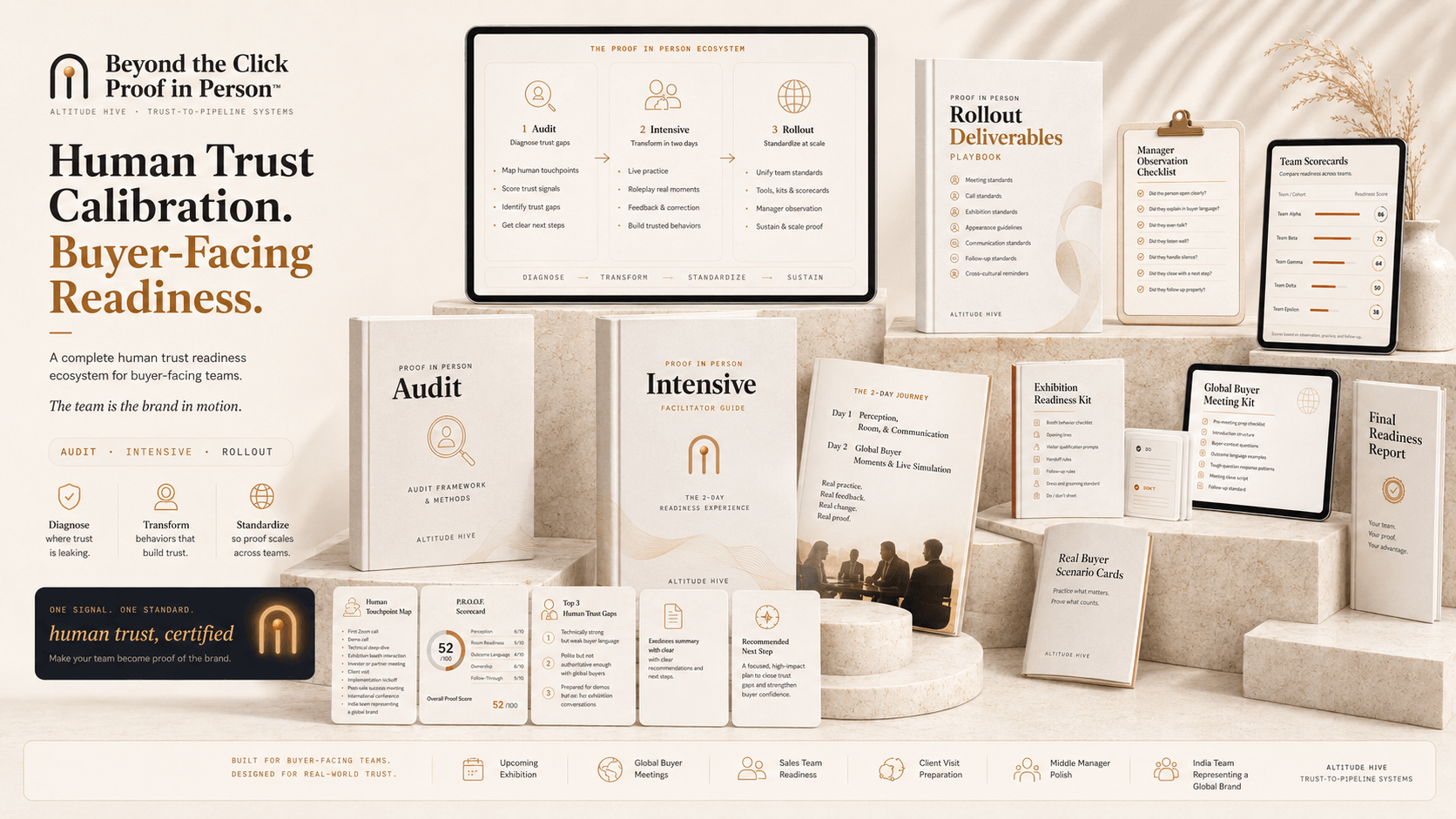
A glimpse of the Proof in Person experience your team steps into.
What the audit includes
A focused call to understand the ground truth:
This gives the audit business context — not training for its own sake.
We map the real moments where buyers experience your team:
It can also include technical deep-dives, partner meetings, implementation kickoffs, post-sale calls, and an India team representing a global parent brand.
The map shows where human trust is created, protected, or lost.
We review buyer-facing moments through the P.R.O.O.F. Mechanics:
We’re not hunting flaws. We’re finding trust signals.
Your team is scored across the five trust areas:
Readiness becomes a number — not a vague opinion.
From the full picture, we isolate the three most likely to cost you confidence. Common ones:
Only the three gaps that matter — no random training plan.
You receive a short, leadership-ready report:
Clarity for leadership — and a way to explain the need without sounding like generic soft skills.
A low-risk first step — credited if you go further.
A clear diagnosis of where your buyer-facing team is creating trust — and where it is leaking.
- Number of people reviewed.
- Number of buyer touchpoints.
- Number of teams involved.
- Whether recorded calls are available.
- Whether roleplays are needed.
- Whether exhibition readiness is included.
- Whether global buyer readiness is included.
- Whether in-person observation is required.
Travel and stay are separate if in-person observation is needed.
If we cannot identify at least three clear human trust gaps, you do not pay for the audit.
At the end of the audit, you will know the top human trust gaps affecting your buyer-facing team. No fake revenue promise. No inflated claim. Just a clear diagnosis of where the human layer is helping — or hurting — trust.
Then, one of two paths forward.
Once the audit is complete, there are two possible next steps.
A two-day offline facilitated readiness experience.
Best for
The team practices real situations. Not generic exercises. Examples:
The goal is visible readiness improvement.
A multi-cohort implementation for larger teams.
Best for
The rollout creates:
This helps the company stop depending on individual personality. The standard becomes shared. Managers can coach it. Teams can practice it. New people can learn it. Leadership can track it.
Tools that make the behaviour survive the session.
Depending on the program, the company can receive:
These are not extra documents for decoration. They help the behaviour survive after the session ends.
Attention is one person’s job. Confidence is the whole team’s.
A strong product can get attention.
A strong brand can create interest.
A strong founder can open doors.
That matters when —
Proof in Person helps the company create a stronger human trust layer — so buyers do not feel a gap between what the company promises and how the team shows up.
No inflated claims. A grounded promise.
✕ What this work does not promise
It does not promise that every buyer will close. That would be false.
It does not promise instant revenue.
It does not claim that presence alone wins deals.
✓ What you can expect
Your team becomes more aware of how they are perceived.
They understand the human signals that affect buyer trust.
They practice the moments that usually create doubt.
They show up with more clarity, readiness, and calm authority.
Leadership gets a clearer standard to coach from. Managers know what to observe. Teams know what good looks like.
Buyers should experience a team that feels more prepared, more aligned, and more credible.
That is the work.
The question is not:
“Does our team need training?”
The better question is:
“When buyers meet our team, does trust go up or down?”
If the answer is unclear, there is a trust gap worth finding.
And the best first step is the audit.
Book a Buyer Room Readiness Call.
This call is for companies that want to understand whether their buyer-facing team is creating trust — or leaking it.
We will look at:
This is not a generic training discussion. It is a trust gap conversation.
The goal is simple: find the first human trust gap worth fixing.
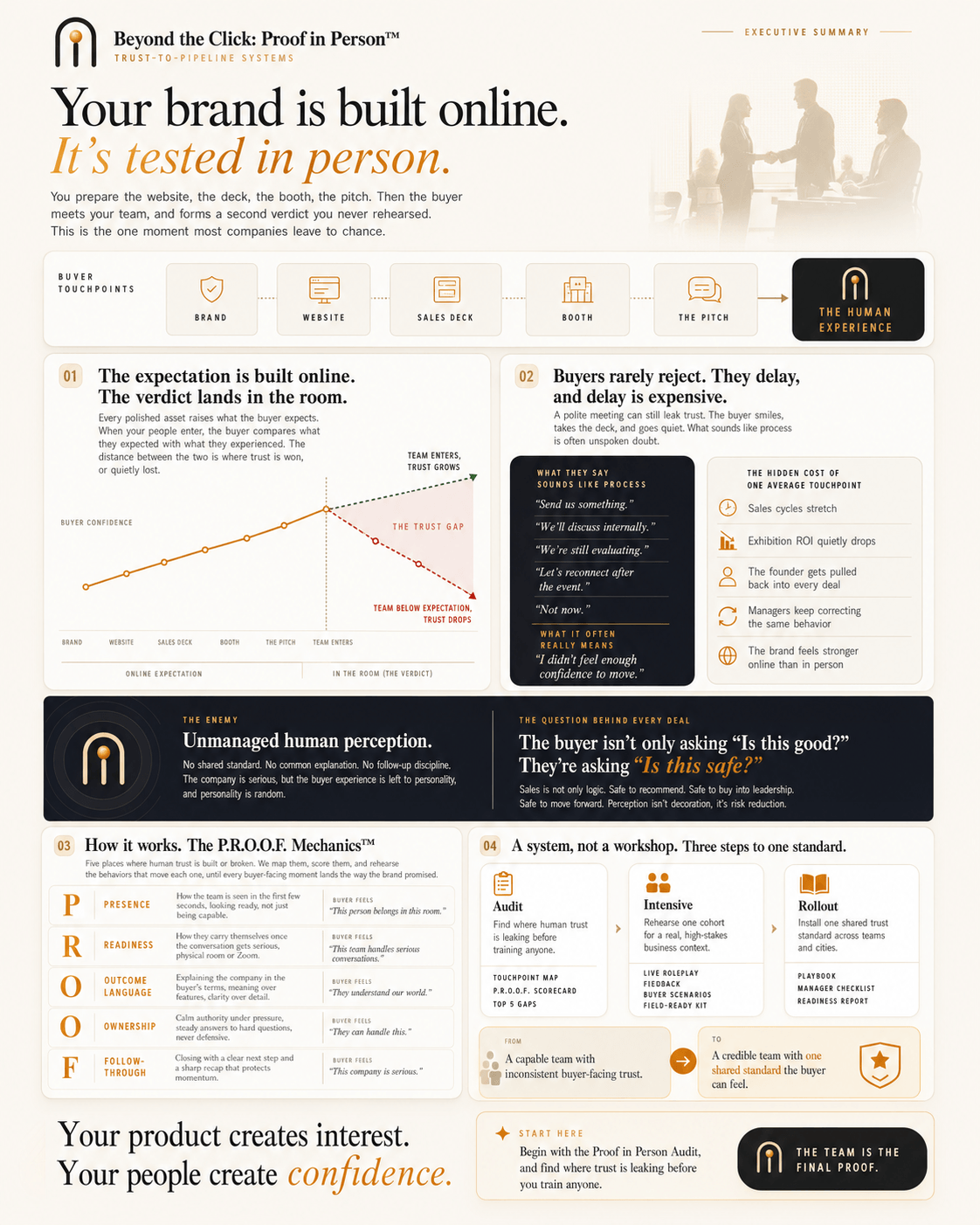
The whole argument, on one page.
Most decisions aren’t made by the person on the call. This is the executive summary — hand it to the people who weren’t in the room.
as your product feels online.

I kept seeing the same pattern — strong companies, sharp products, and a quiet drop in trust the moment a real person entered the room. Proof in Person exists to close that gap. This page is the whole argument. The call is where we find your first trust gap worth fixing.